


























How Pope Francis Bridges a Divided World Through Language

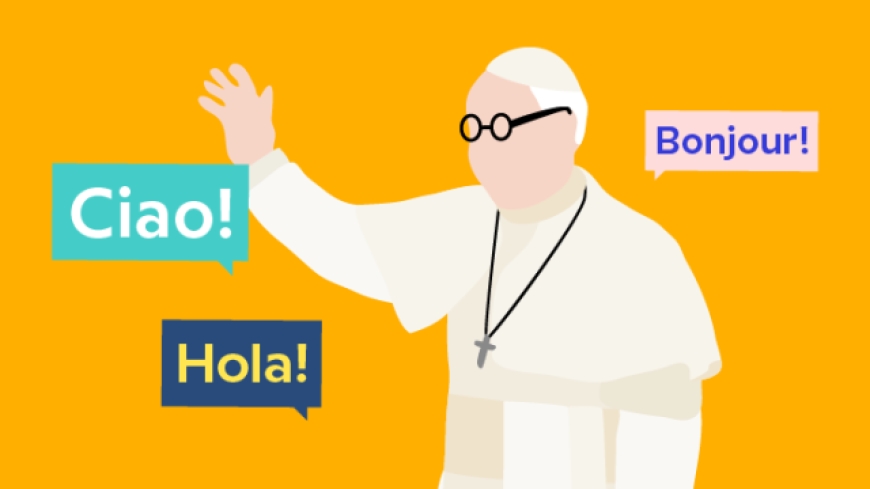
It's easy to forget, in the polished rituals of Vatican City, that the man in white who stands on the balcony and addresses billions is not just a spiritual figure; he's also a translator of hope, a cultural bridge, and a polyglot peacemaker.
What languages does the Pope speak? That question, seemingly simple, reveals so much about the role Pope Francis plays on the global stage. His words don't just fill pews; they echo across continents, from rural chapels in the Philippines to protest squares in Europe. And every syllable matters.
Language is power. And for Pope Francis, it's not just a tool, it's a ministry.
Born Multilingual: The Argentine Foundation
Long before he became the Bishop of Rome, Jorge Mario Bergoglio was just a boy growing up in Buenos Aires. That meant one thing: multilingual exposure from the very start.
His parents were Italian immigrants, and like many Argentine families of the time, theirs was a home where Spanish and Italian intermingled at the dinner table. From childhood, he was raised with a natural comfort in navigating languages, not just speaking them, but understanding their deeper cultural textures.
That early immersion laid the groundwork for a man who would one day need to speak to the entire world. So when people ask, "What languages does Pope Francis speak?" the answer begins here in the complex identity of an Argentine with Italian roots and a global calling.
Latin: The Language of the Church
Of course, no discussion about papal languages is complete without mentioning Latin. Though rarely spoken conversationally today, Latin remains the official language of the Catholic Church. Encyclicals, official documents, and many liturgical rites are still crafted in this ancient tongue.
Pope Francis understands and uses Latin, particularly in formal communications. Yet, it's interesting how he uses language as a bridge, not a barrier. Unlike some of his predecessors, he often chooses to speak in the vernacular, even when tradition might suggest otherwise.
It's a symbolic gesture, his way of saying, "This isn't about grandeur. It's about getting through to you, in your language."
Italian: His Vatican Day-to-Day
Italian, unsurprisingly, is the working language of Vatican City. The Pope conducts most meetings, addresses, and homilies in Italian. It's the language of diplomacy within the Holy See and the everyday rhythm of Vatican life.
For Pope Francis, Italian is second nature. Not just because of his heritage, but because it allows him to connect with the Curia, the press, visiting leaders, and the people of Rome with ease. You'll often hear him crack a joke or add a spontaneous remark during public events in Italian. It's where his warmth and humanity shine most naturally.
Spanish: Heart Language of a Shepherd
Still, if there's one language that seems closest to Pope Francis's soul, it's Spanish. It's the language of his prayers, his past, and perhaps, his most unfiltered moments.
When addressing Latin America, or when speaking emotionally about issues like poverty, injustice, or environmental responsibility, Pope Francis often switches to Spanish even if a translator is available.
It's telling. Spanish isn't just the language he knows; it's the language he feels. It's a heartbeat, not just a tool. And that nuance is something that even the best automatic translators can't fully capture.
That's precisely why The Spanish Group, a leader in professional translation, often emphasizes the human touch in multilingual work. Because meaning is more than accuracy, it's emotion, rhythm, and intent. Machines can swap words. But people carry context. That's why global communicators from law offices to religious institutions trust services like The Spanish Group for certified, culturally attuned translations.
Does the Pope Speak English?
Here's where things get interesting. People often ask, "Does the Pope speak English?" The answer is: yes, but it's not his preferred language.
Pope Francis understands English and has used it in public addresses, most notably during his 2015 visit to the United States, but it's clearly a language he approaches with measured care. His English has a noticeable accent, and he tends to read from prepared remarks when using it.
That's not a limitation. It's a decision rooted in respect. He doesn't want linguistic missteps to dilute his message. So, when he speaks English, it's deliberate, thoughtful, and usually reserved for occasions where clarity and diplomacy are crucial.
And yet, even with this cautious approach, his presence transcends the language barrier. The emotional intelligence in his delivery, the pauses, the facial expressions, and the careful pacing still communicate more than the words themselves.
So if you've ever found yourself asking, "Does the Pope speak English?" Yes, he does. But more importantly, he knows when and how to use it.
Other Languages in the Pope's Repertoire
In addition to Spanish, Italian, Latin, and English, Pope Francis also has a functional understanding of German, acquired during his doctoral studies in theology. He's also been heard reading prayers or blessings in French, Portuguese, and Polish during international Masses or papal visits. These are usually ceremonial phrases rather than full speeches, but again, they matter.
Even a few words in someone's mother tongue can change how they hear the message, and it says, "I see you. I respect your culture. You matter."
That level of multilingual empathy is a cornerstone of modern leadership, and it's something translation services must replicate in written form, too. That's where companies like The Spanish Group prove invaluable. They don't just convert documents from one language to another; they ensure the soul of the message survives the journey.
A Language of Unity
At the end of the day, what languages the Pope speaks is more than a trivia question. It's a mirror to how one of the world's most influential figures chooses to reach people.
He could speak only from behind the curtain of traditional Latin and formality. But he doesn't. Pope Francis meets the world where it is multilingual, multicultural, messy, and beautiful. He knows that language isn't just about understanding. It's about belonging.
And in a time when so much divides us, that message, that gesture of multilingual connection might be the most powerful sermon of all.
Let me know if you'd like a visual-rich version for web publishing, a compressed version for social media, or if you'd like to explore multilingual blog editions.


