The Science Behind the Stretch Forming Process

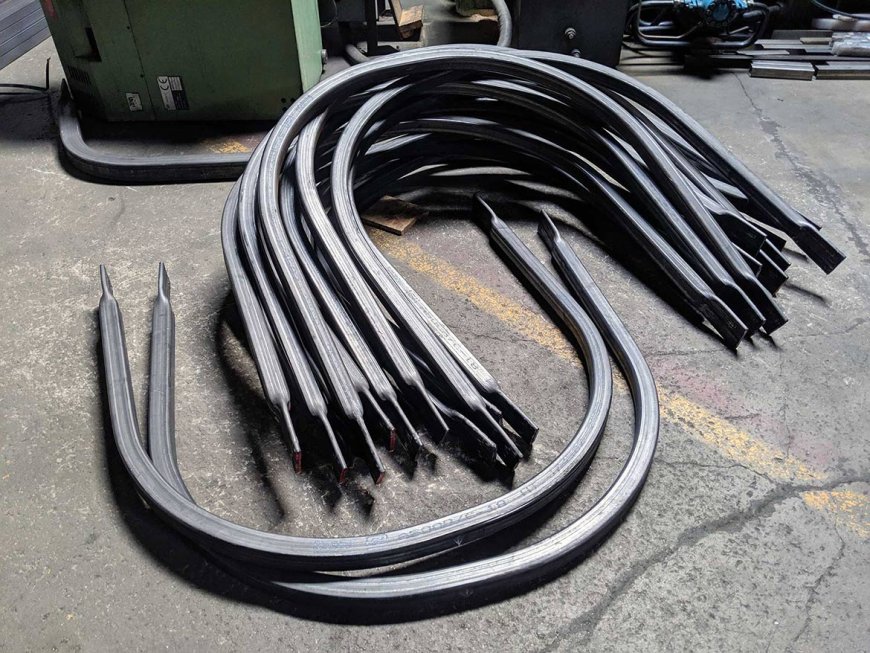
In the ever-evolving world of metal fabrication, the demand for precision, strength, and consistency has led to the rise of advanced forming techniques. Among these, the Stretch Forming Process stands out as a highly reliable and scientifically grounded method, particularly effective for shaping complex curves in large metal components. Whether it's in aerospace, automotive, or architecture, this technique is revolutionizing the way manufacturers achieve complex forms without compromising material integrity.
Lets explore the science behind this fascinating process and understand why STRETCH ROLL FORMING is becoming a preferred choice for engineers and fabricators alike.
What is the Stretch Forming Process?
At its core, the Stretch Forming Process is a metal forming method in which a sheet or extruded metal is stretched and simultaneously bent over a die. This process is used to produce smooth, curved surfaces with high precision, eliminating the need for multiple joining or welding steps that can weaken structural integrity.
The metal is clamped at both ends by gripping jaws or clamps and then stretched beyond its yield point while being wrapped around a form or die. This controlled plastic deformation results in a permanent curved shape, matching the die's profile.
Materials Used in Stretch Forming
Different types of metals respond differently to tension and bending. The Stretch Forming Process is best suited for ductile materials that can undergo plastic deformation without cracking. Common materials include:
- Aluminum alloys Widely used in the aerospace and automotive industries due to their lightweight properties and good ductility.
- Steel and stainless steel Used in heavy-duty structural applications.
- Titanium Ideal for aerospace and medical applications where strength-to-weight ratio is critical.
- Copper and brass Commonly used for decorative and architectural applications.
Understanding the metallurgical properties of these materials is crucial, as it directly impacts the amount of force needed and the degree of stretch possible before failure.
The Science: Plastic Deformation and Yield Point
The central scientific principle behind stretch forming is plastic deformationthe point at which a metal can be permanently reshaped without breaking. Each metal has a yield point, which is the stress level at which it begins to deform plastically.
In the Stretch Forming Process, the material is intentionally stretched just beyond this yield point. Unlike elastic deformation (which is reversible), plastic deformation allows the material to retain its new shape after the stress is removed. This ensures that the metal conforms precisely to the contours of the forming die.
Engineers must calculate:
- Elastic limit (to avoid springback)
- Ultimate tensile strength
- Strain rate sensitivity
- Necking threshold
These values vary based on the metal and temperature, making it essential to control the environment and mechanical forces during forming.
How STRETCH ROLL FORMING Differs from Traditional Bending
While both stretch forming and roll forming involve shaping metal, STRETCH ROLL FORMING combines aspects of stretch forming and roll bending to offer a more continuous, efficient, and uniform process for long, curved profiles.
Key Differences:
Feature
Traditional Bending
STRETCH ROLL FORMING
Forming Mechanism
Simple bend or press brake
Simultaneous stretch + roll
Material Movement
Static or incremental
Continuous
Deformation Control
Limited
High precision with tension control
Springback
High
Significantly reduced
Surface Finish
Can be inconsistent
Smooth and uniform
In STRETCH ROLL FORMING, the sheet is progressively bent by passing it through a series of rollers while being subjected to stretching force. This hybrid approach minimizes residual stress, reduces defects like warping, and enables tight radii with consistent curvature.
Applications of the Stretch Forming Process
Thanks to its versatility and precision, the Stretch Forming Process has a wide range of industrial applications, including:
1. Aerospace Industry
Aircraft fuselage skins, wing panels, and window frames often require complex curvatures that traditional methods cant achieve without added weight or structural weakness. Stretch forming allows for seamless panels with high aerodynamic and structural performance.
2. Automotive Manufacturing
In luxury and performance vehicles, sleek curves and aerodynamic bodies are made possible by stretch forming techniques, especially with aluminum panels.
3. Architecture and Construction
Curved roofing structures, domes, and faade elements are increasingly being fabricated using STRETCH ROLL FORMING due to the ability to create consistent, flowing curves with minimal joints.
4. Rail and Shipbuilding
Stretch forming allows for smooth, strong, curved metal panels used in rail car and marine hull construction.
Benefits of Stretch Roll Forming
The adoption of STRETCH ROLL FORMING continues to grow because of the following key advantages:
- Improved Dimensional Accuracy: Maintains tight tolerances, even for large and complex parts.
- Reduced Material Waste: Efficient use of material through precise shaping.
- Enhanced Surface Finish: Reduced risk of surface cracks or scratches.
- Lower Labor and Assembly Costs: Fewer welding and fastening steps required.
- Repeatability: Perfect for high-volume production with consistent results.
- Less Springback: Due to tension control, the final product holds its shape better than with standard forming.
Challenges and Considerations
Despite its many advantages, the Stretch Forming Process requires a deep understanding of material science and precision machinery. Factors such as:
- Die wear and maintenance
- Clamping pressure
- Stretch ratio
- Temperature control
...must be closely monitored to avoid product failure or inconsistency. Furthermore, setup and tooling can be costly, making it more suitable for medium to high-volume production where the return on investment justifies the equipment.
Automation and Modernization
With the advent of CNC machines and programmable control systems, stretch forming has become more accurate and efficient. Today, automated STRETCH ROLL FORMING machines can monitor force application in real time, adapt die positions on-the-fly, and even integrate quality checks within the process.
Machine learning and AI are also being implemented to optimize force parameters and predict material behavior, reducing trial-and-error during new part development.
Conclusion
The Stretch Forming Process is a brilliant fusion of mechanical science and metallurgical precision. By understanding how materials behave under tension and using that knowledge to manipulate metal beyond its elastic limit, manufacturers can create strong, lightweight, and beautifully curved components.
The addition of STRETCH ROLL FORMING to this technique opens new doors for efficiency, quality, and repeatability. As technology continues to evolve, this method will remain a cornerstone of advanced fabrication techniques.
To learn more about how this process is shaping the future of manufacturing, visit:
https://ms-machining.com/stretch-forming-process/