Simplify Operations with Robotic Process Automation
Simplify operations with Robotic Process Automation (RPA). Automate repetitive tasks, improve accuracy, cut costs, and boost efficiency while enabling employees to focus on strategic work.

Businesses today are under constant pressure to improve efficiency while reducing costs. Manual workflows are not only slow but also prone to errors.Robotic Process Automation (RPA) offers a way out, allowing organizations to simplify operations by automating repetitive digital tasks. Unlike traditional automation, RPA uses bots that can adapt across multiple platforms without changing core systems, making it a flexible tool for transformation.
Understanding Robotic Process Automation in Simple Terms
RPA is a technology that uses software robots, or bots, to perform repetitive, rule-based tasks that would otherwise require human effort. Instead of employees spending hours on manual data entry, report generation, or routine checks, RPA handles these processes faster, with greater accuracy, and without fatigue.
Key Features of Robotic Process Automation
-
Repetitive Task Automation: RPA excels at handling structured, routine work such as data entry or form processing.
-
System Integration: Bots can connect across multiple applications and systems without requiring major changes to existing infrastructure.
-
Accuracy and Reliability: Unlike humans, bots do not make careless mistakes, ensuring high-quality outputs.
-
Scalability: RPA systems can be scaled up or down according to workload, making them highly flexible to meet business needs.
-
Cost Efficiency: By automating manual labor, RPA enables organizations to reduce costs while enhancing productivity.
Common Applications of RPA
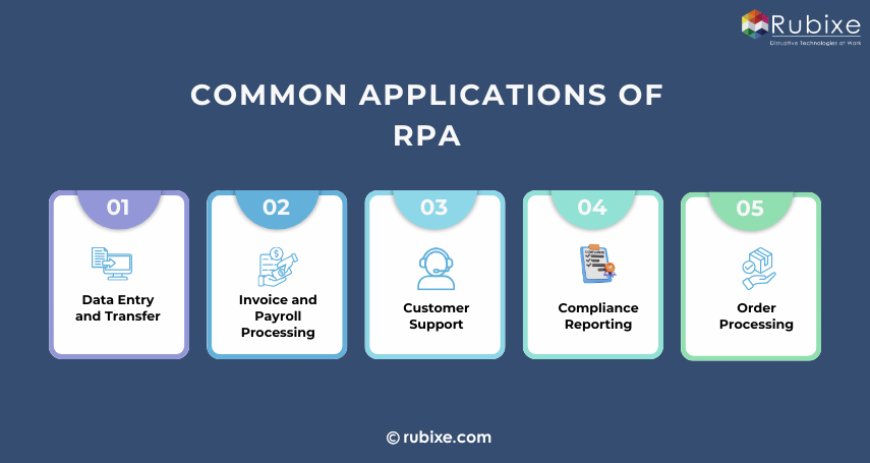
Robotic Process Automation is not limited to one industry or department. Its versatility makes it a valuable tool across finance, HR, customer service, and operations. By taking over repetitive and time-consuming tasks, RPA allows employees to focus on higher-value activities like decision-making, strategy, and innovation.
Examples of RPA Applications
-
Data Entry and Transfer: Automating the movement of data between spreadsheets, CRMs, and other enterprise systems ensures accuracy and reduces human error.
-
Invoice and Payroll Processing: RPA bots can validate invoices, calculate payments, and process payroll seamlessly, helping finance teams close tasks faster.
-
Customer Support: Chatbots and virtual assistants can instantly respond to common queries, escalate issues when needed, and streamline ticket management.
-
Compliance Reporting: Bots generate audit-ready reports, maintain transaction logs, and ensure adherence to industry regulations, reducing compliance risks.
-
Order Processing: From verifying customer details to updating shipment statuses, RPA accelerates order cycles and minimizes delays in supply chain operations.
Real-World Example of Robotic Process Automation
Robotic Process Automation is making a measurable impact across industries, and one of the best ways to understand its value is through real-world success stories.
Case Study: Deutsche Bank
Deutsche Bank adopted RPA to handle large volumes of repetitive financial processes such as compliance checks, account reconciliations, and transaction monitoring. By automating these tasks, the bank achieved the following:
-
Faster processing times: Work that previously took hours could be completed in minutes.
-
Cost efficiency: Operational costs were reduced significantly by minimizing manual intervention.
-
Improved compliance: Automated reporting ensured accuracy and timely submissions to regulatory authorities.
-
Enhanced employee focus: Staff was freed from routine work and redirected toward client-facing and strategic initiatives.
This case demonstrates how RPA can transform traditional banking processes, ensuring efficiency while maintaining compliance standards.
Robotic Process Automation in Software Testing
Software testing is a critical yet time-consuming part of IT operations. Traditional regression and functional testing often require repetitive manual effort, which slows down release cycles. Robotic Process Automation (RPA) is changing this landscape by automating testing tasks and ensuring faster, more reliable results.
Key applications of RPA in software testing include:
-
Running functional and UI test cases: RPA bots can execute repetitive test scenarios across multiple environments, ensuring consistency and accuracy.
-
Automating data input validation: Bots validate large sets of input and output data, reducing human errors and saving testing time.
-
Identifying mismatches with real-time alerts: RPA tools instantly flag discrepancies, allowing teams to resolve defects early in the development cycle.
-
Supporting faster product release cycles: By automating repetitive testing, organizations can shorten release timelines while maintaining software quality.
With RPA in testing, businesses can achieve higher accuracy, reduce manual workloads, and accelerate their digital transformation journeys.
Key Benefits Businesses Experience with RPA
Adopting Robotic Process Automation (RPA) enables businesses to streamline operations while unlocking measurable value. By automating repetitive and rule-based tasks, companies not only save time and money but also create a more efficient and satisfied workforce.
Some of the major benefits include:
-
Improved accuracy: Bots strictly follow predefined rules, eliminating human errors and ensuring consistency.
-
Faster cycle times: Tasks that previously took hours can now be completed in just minutes.
-
Lower operational costs: Automation reduces manual intervention, delivering significant cost savings.
-
Enhanced compliance: Every action performed by bots is logged, providing a clear trail for audits and regulatory requirements.
-
Happier workforce: Employees are freed from repetitive tasks, allowing them to focus on higher-value, strategic work.
How to Approach RPA Implementation
Implementing Robotic Process Automation (RPA) is not just about deploying botsit requires a strategic, step-by-step approach to ensure success and long-term scalability. Organizations should focus on aligning RPA initiatives with business goals, selecting the right processes, and ensuring proper governance.
Key steps to approach RPA implementation include:
-
Identify suitable processes: Start with repetitive, rule-based tasks that deliver quick wins when automated.
-
Define clear objectives: Set measurable goals such as cost savings, efficiency improvements, or compliance gains.
-
Choose the right RPA tool: Evaluate platforms based on scalability, integration capabilities, and ease of use.
-
Pilot before scaling: Run small-scale implementations to test performance and refine workflows.
-
Engage stakeholders: Involve IT, operations, and employees early to encourage adoption and reduce resistance.
-
Ensure governance and security: Establish policies for bot monitoring, compliance, and data protection.
-
Scale strategically: Expand automation gradually across departments while tracking ROI and business impact.
Choosing the Right RPA Tools
The success of Robotic Process Automation depends heavily on selecting the right tool for your business. Different RPA platforms offer varied features, integration capabilities, and scalability, so organizations must evaluate their unique needs before making a decision.
When choosing an RPA tool, consider the following factors:
-
Ease of Use: A user-friendly interface with low-code or no-code capabilities allows business users to build automations without heavy IT involvement.
-
Scalability: The tool should support growing automation needs across multiple departments and processes.
-
Integration Capabilities: Strong compatibility with ERP systems, CRM platforms, databases, and cloud services ensures smoother workflows.
-
AI and Analytics Support: Advanced platforms combine RPA with AI, machine learning, and analytics for smarter automation.
-
Security and Compliance: Look for features like role-based access control, audit trails, and data encryption.
-
Cost and ROI: Consider licensing fees, implementation costs, and long-term return on investment.
-
Vendor Support and Community: Strong documentation, training, and active user communities can significantly reduce learning curves.
Popular RPA tools in the market include UiPath, Automation Anywhere, Blue Prism, and Microsoft Power Automate, each catering to different business needs and levels of technical expertise.
The Future of Robotic Process Automation
Robotic Process Automation is evolving from simple rule-based bots to intelligent, decision-making systems. The next wave of automation will integrate RPA with advanced technologies, making business operations faster, more adaptive, and more efficient. Instead of just executing tasks, future RPA will focus on enhancing human potential and driving strategic value.
Key trends shaping the future of RPA include:
-
Hyperautomation: The fusion of RPA with artificial intelligence, machine learning, and analytics will enable end-to-end intelligent workflows, reducing manual oversight.
-
Cloud-First RPA: Cloud-based solutions will make automation more affordable and accessible, especially for small and mid-sized businesses.
-
Industry-Specific Solutions: Customized RPA platforms for sectors like finance, healthcare, telecom, and logistics will improve precision and compliance.
-
Collaborative Bots: Rather than replacing employees, bots will act as digital coworkers, handling repetitive work so humans can focus on creativity and decision-making.
-
Enhanced Governance and Security: As adoption increases, future RPA platforms will embed stronger compliance, data privacy, and audit features.
-
Scalable Automation Ecosystems: Businesses will move from automating single tasks to deploying enterprise-wide automation strategies for holistic efficiency.
AI consulting is no longer just a trend; it has become a proven approach to simplifying operations, reducing costs, and boosting business performance. From AI consulting use cases in banking to applications in software testing, its versatility enables organizations across industries to transform workflows and make smarter decisions.