Trust by Design: How Proof-First Systems Are Reshaping AI Architectures?
Examine how proof-centric AI systems are emerging leveraging cryptography, modular blockchains, and smart devices to deliver verifiable trust without exposing data.

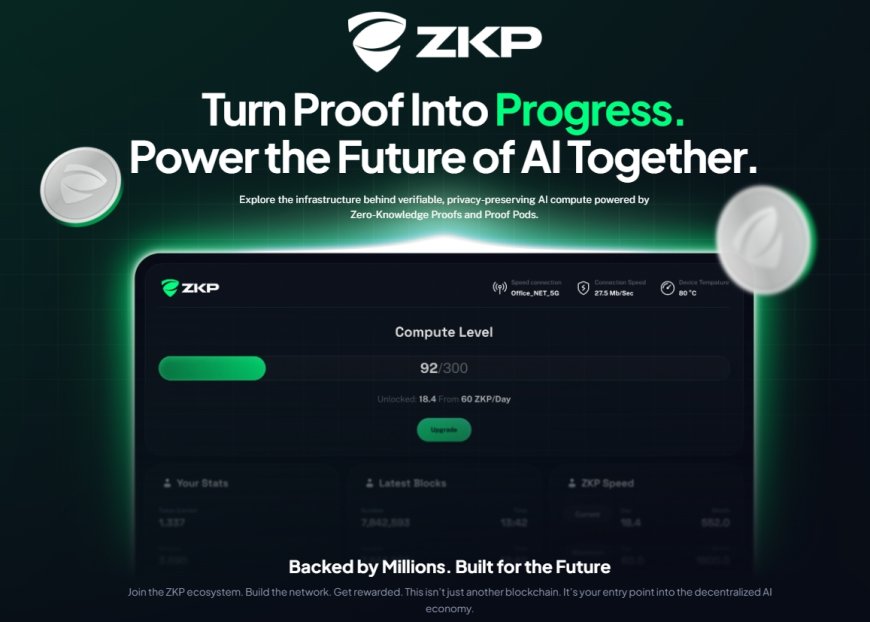
In many modern systems, we are asked to hand over data and place blind trust in claims: “Our AI is fair,” “Your information is safe,” “This result is accurate.” But for many people, that level of faith feels insufficient especially when personal information, corporate data, or sensitive signals are at stake. A new architectural paradigm is emerging to change that: systems built not around promises, but verifiable proof. These systems enable privacy, transparency, and trust to coexist, rather than compete.
At the core of this shift is the idea of zero-knowledge proof blockchain an ecosystem where cryptographic proofs ensure correctness without revealing sensitive inputs. When woven into AI, devices, and modular infrastructure, proof-first designs let contributors participate, models learn, and auditors verify—while keeping private what matters. Let’s dive into how this is being constructed, where it matters, and what challenges lie ahead.
From Promise to Provable: What Makes Proof-First AI Possible
To understand proof-first systems, it helps to break down how privacy, proof, and architecture align.
Contributor Devices & Privacy Control
One of the most visible elements in such systems are hardware or software endpoints (often called proof pods) that let users share selected signals under strict privacy control. Instead of uploading all raw data, you might:
-
Choose which types of data or metrics to share (e.g. anonymized telemetry rather than detailed logs)
-
Define timing, frequency, and level of aggregation or obfuscation
-
Remain pseudonymous or anonymous, depending on your preferences
-
View a dashboard that shows how your contributions are used, how they influence model training, and what proof verification they enable
These devices shift the user from passive data provider into an active steward—one who retains oversight and agency.
Verifiable Computation & Proof Verification
Granting privacy isn’t the end goal—ensuring that AI or compute tasks operate correctly, fairly, and transparently is equally important. That’s where cryptographic proof systems (e.g. zk-SNARKs, zk-STARKs) come in: they let one party generate a proof that a computation was done correctly without showing the internal data.
In practice, that means:
-
Model inference or training can be audited—verifiers can confirm outputs without seeing private inputs
-
Fairness or compliance checks can be done externally without exposing sensitive datasets
-
Data contribution validation can be proved (e.g. that a contributor’s signal was within expected bounds) without revealing the raw signal
Proofs replace blind trust with verifiable guarantees.
Modular Architecture & Data Layers
To scale privacy-proof AI infrastructures, architecture is often modular:
-
Consensus & verification layers: Nodes verify not just state or storage, but also compute correctness via proofs
-
Runtime / application layers: Support for smart contracts (e.g. EVM, WASM) and AI inference modules in adaptable environments
-
Off-chain data storage with cryptographic anchoring: Large datasets or models live off the chain (e.g. IPFS, Filecoin) but are tied to the blockchain via integrity proofs (Merkle roots, commitments)
-
Hybrid consensus models: Combine storage proofs (proof-of-space or similar) and compute proofs to align incentives across memory, compute, and validation
This layering enables high throughput, privacy protection, and modular upgrades without compromising the proof guarantees.
Incentive & Token Mechanisms
Proof-first systems flourish when participants—not just users, but validators, storage providers, model trainers—are rewarded. A well-designed incentive structure ensures:
-
Contributors see how much value their input generated and how their rewards are calculated
-
Roles (data providers, validators, compute nodes) receive fair compensation
-
Transparency in reward flows, ideally with proofs or logs to audit reward claims
-
Incentive models discourage centralization or dominance by any one actor
When incentives are aligned, participants invest in integrity, not just throughput.
Domains Where Proof-First AI Makes a Difference
These privacy-proof systems are not abstract they’re particularly valuable in settings where data sensitivity and trust matter most.
Healthcare & Research Collaboration
Medical datasets are crucial for advanced diagnosis, predictive models, or personalized therapies. But privacy laws and ethics often block raw data sharing. Proof-first architectures let hospitals, labs, or research institutions jointly train or validate AI models without exposing identifiable patient data. Proofs confirm correctness; privacy stays protected.
Enterprise & Private Data Ecosystems
Many businesses hold sensitive datasets customer behavior, operational metrics, proprietary workflows. Proof-based AI allows collaboration, audits, or shared model validation without exposing internal data. The system can attest to correctness, fairness, or alignment while preserving confidentiality.
Public Accountability & AI Governance
When governments or oversight bodies deploy AI for services, policy, regulation transparency is demanded. Yet exposing raw inputs (e.g. citizen data) is often unacceptable. Proof infrastructure enables independent audits, fairness checks, or compliance reviews without revealing underlying sensitive information. Auditors can verify outcomes without seeing everything that fed into them.
Edge, IoT & Federated Devices
Sensors, smart devices, and edge networks generate voluminous streams of data—often with privacy implications (health trackers, home devices, behavioral sensors). Proof-first systems allow devices to contribute anonymized signals or aggregated statistics, and to prove their validity. AI models improve, but individual privacy is preserved.
Challenges & Trade-Offs: Building Proof-First Systems Is Hard
The promise is high but so are the costs and complexities. Some key challenges:
-
Proof Performance Overhead: Generating and verifying proofs, especially for large AI models or frequent inference, can be expensive in compute, latency, and energy usage.
-
Hardware Accessibility: Contributor devices must be affordable, user-friendly, durable, and secure. Barriers in cost or complexity restrict adoption.
-
User Interface & Privacy Literacy: Offering fine-grained control is good in theory, but difficult in practice. If privacy controls are confusing or opaque, users may misconfigure or avoid them.
-
Regulatory Diversity: Data privacy, cryptographic controls, and AI regulation vary across jurisdictions. Proof systems must adapt to legal boundaries and comply without undermining privacy.
-
Incentive Design Risks: Reward systems must balance contributions across roles, avoid gaming or centralization, and remain sustainable over time.
-
Transparency vs Secrecy Balance: Some AI tasks require visibility (interpretability, audit). Others demand secrecy. Deciding what to expose—and to whom is delicate.
Advances & Research Frontiers
Several technical and research trends are pushing proof-first architectures forward:
-
Scalable Proof Protocols: Research is improving proof generation speed, reducing proof sizes, and optimizing circuit design so proofs are more practical for real-world AI loads.
-
Federated ZK Consensus: New frameworks combine zero-knowledge proofs with federated learning, enabling decentralized model updates that are provably correct.
-
AI-Assisted Proof Optimization: Using machine learning to design or select efficient proof circuits or parameters adaptively.
-
zk-IoT & Device-Level Security: Protecting firmware, data pipelines, and device integrity via proof mechanisms in distributed sensor systems.
-
Frameworks for deploying proofs on real-world data: Some academic works (e.g. Fact Fortress) propose abstraction layers that let developers code computations without thinking about circuits.
Final Reflections: Trust Reimagined
We are shifting from a world where users must surrender privacy to gain utility, into one where systems are built so that privacy and proof coexist. Proof-first AI architectures make it possible for data to remain hidden while contributions remain useful and verifiable.
The transition isn’t trivial costs, design complexity, regulatory alignment, and usability all present real challenges. But the direction is clear: trust shouldn’t require blind faith; it should be demonstrable and verifiable.