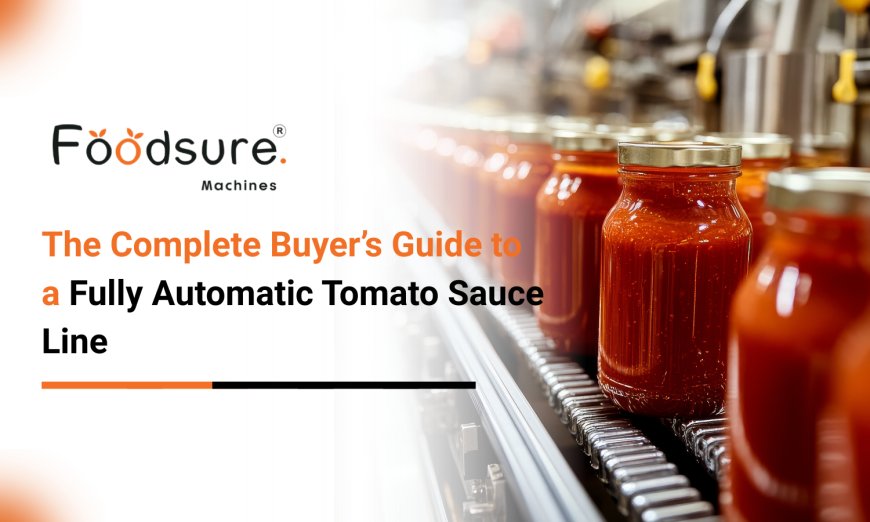
The Complete Buyer’s Guide to a Fully Automatic Tomato Sauce Line
A complete guide on selecting a fully automatic tomato sauce line, including specs, production capacity, and ROI for food manufacturers.
The appeal of packaged tomato sauces is increasing in the food market. Consistency, safety, and speed matter in every aspect of customer contact, from quick service restaurants to retail shelf space. Many of the smaller to mid-sized manufacturers have semi-automated installation, and they can not consistently hold the volume, quality, and compliance.
This guide is going to introduce you to an informative read that will unveil everything you would like to know about investing in an automatic tomato sauce line, with everything from capacity and specs, ROI potential, and suppliers. By the end of this guide, you should know what to ask, compare against when having to make a decision, and the best lifetime dollar investment.
Why Move to a Fully Automatic Tomato Sauce Line?
Automation is not solely about efficient capacity; it is about ensuring your business is sustainable.
-
Increased throughput capability: a line operating at 500 to 1,000 kg/hr will typically allow you to reduce production times by 40% to 60%.
-
Hygiene compliance: the SS316 construction will help prevent the chance of contamination, along with the CIP (Cleaning in Place) system and automatic seals.
-
Lower labour rates: this means we aren't reliant on larger teams of skilled operators, and direct manual interaction is reduced.
-
Consistent product uniformity: automated cooking, blending, and filling processes ensure every batch will look and taste the same.
If your competition is within export markets, or you're supplying a modern retail account, having full automation is not preferred; it is mandatory.
Must-Have Features of a Fully Automatic Tomato Sauce Line
When choosing a fully Automatic Tomato Sauce Line to achieve your production goals, make sure to pair the capacity with the ability to scale. Some considerations to have:
Capacity (kg/hr) & Modular Scalability
Capacity of systems is typically offered as 200 kg/hr, 500 kg/hr, or 1,000+ kg/hr. It is advisable to have a system that meets your needs/goal with at least some opportunity to scale up from there. The modular system can enable more fillers, packaging units, etc., in the same operational line without pulling out your entire operating line.
Filling/Packaging
Will your sauce go into a glass bottle, a PET bottle, a bag, pouches, or cans? The packaging system you have must match the end product. Some production line systems design the filling systems to be replaceable, so you will have some flexibility for your product and filling application.
Cooking, Heating, and Vacuum Systems
High-efficiency cooking modules include steam kettles with agitation, which will prevent sticking and produce a properly cooked product. Vacuum systems will hold colour and flavour, which is important for your expensive sauces.
CIP and hygiene standards
Automatic CIP systems are designed to clean the line in place automatically, without having to remove any equipment. Food contact parts will need to be SS316 and FDA-approved gaskets and seals. Not only do we improve compliance, but we also improve operating time and labour savings.
The Real Cost and ROI of a Tomato Sauce Line
Acquisition is not the only cost you need to think about when it comes to an asset. Consider the following:
-
CapEx: The acquisition price of the machinery (this will change based on capacity, supplier, etc.).
-
OpEx: Utility costs (steam/electricity/water, etc.), labour costs, maintenance costs, etc.
-
ROI: If you can operate a line that can handle 500 kg/hr of capacity, you would generally pay for the asset in 12–18 months, as you can minimise the labour and reduce the amount of product wasted.
Consider the Thought Example ROI:
If you can produce 250 kg/hr by hand with 6 operators, then switching to a 500 kg/hr line and only needing 2 operators per shift, you will automatically get at least 40% back yearly in labour.
Setting Up Your Fully Automatic Tomato Sauce Line
Successful commissioning often determines whether you have a value-added investment or a wasted failure. Here are some things you need to think about when preparing for commissioning:
-
A factory floor plan indicating utility points (power, steam, water).
-
A drainage plan for CIP cleaning.
-
Sufficient clearance height for your conveyors and packaging modules.
-
A schedule for operator training as part of your supplier agreement.
Avoid These Costly Mistakes in Tomato Sauce Production
Exaggerated demand: If you only need 200-300 kg/hr, do you need to buy a line rated for 1,000 kg/hr? Not only is that overcapacity, but you are also wasting money on 100%-200% excess capacity if you only need to run the line at 200-300 kg/hr.
-
Ignoring after-sales service: Local service support is worth more than a discount! If you are down, you're losing money. Down time equals lost revenue.
-
Outside of compliance: Always purchase equipment that is FSSC 22000 / ISO 22000 ready. If you're not in compliance, you do not have exports, and you are not able to get a contract, you cannot take delivery of equipment.
-
No spare package: Always budget and buy the spare parts package at the time of installation.
Conclusion
Purchasing a complete, fully Automatic Tomato Sauce Line can enhance your production by gaining capacity, quality assurance, and labor savings. Take your time to analyze your options by reviewing capacity, configurations, roi, and manufacturer support to make a fully informed decision. Get organized and start by taking stock of your process, making a plan for how to set up your kitchen, and requesting a quote to take action to achieve better production and profits.
FAQ
Q1. What is a fully automated tomato sauce production line?
A fully automatic tomato sauce ine is the complete processing line that allows for the washing, cooking, blending, filling, and packaging of tomato sauce products with very little manual labour.
Q2. What is the space needed for a 500kg/hr line?
Typically, a space of approximately 1,200-1,500 square Feet will be sufficient based on the line layout and including the packaging module.
Q3. What utilities are required?
Utilities required for the line are for a source of steam (3-5 bar), electricity (30-50 kW, depending on the automation level of the line), and a water supply for Clean-In-Place (CIP) as necessary.
Q4. Can one line make several recipes?
Yes, one line can make several recipes. With the programmable controller, you can produce ketchup, pizza sauce, and other tomato-based products.
Q5. What is the average communications payback period?
Most small and medium-sized enterprises (SME's) will realize return on investment (ROI) on the line in approximately 12 - 18 months based on factors such as labour cost reduction and food processing throughput.